If you’ve been putting off getting a website because it feels like a bigger project than you have time or budget for right now, this is worth reading. The question of how much website you actually need is one we hear often — and the honest answer is: it depends on what you’re trying to accomplish, and a lot of businesses need less than they think.
Here’s how to figure out where you fall.
What a One-Page Website Actually Is
A one-page website is exactly what it sounds like — a single, well-designed page that covers everything a potential customer needs to know: what you do, who you serve, why you’re the right choice, and how to reach you. It’s not a shortcut or a placeholder. When it’s built well, it’s a complete, professional online presence.
Think of it like a well-organized business card that actually has room to say something. For a lot of small service businesses in Central Oregon — contractors, house cleaners, massage therapists, personal trainers — a one-pager does the job completely.
When One Page Is the Right Call
A one-page site works well when your business has a clear, focused service offering. If someone can understand what you do and decide whether to call you within a minute of landing on your page, you don’t need more real estate than that.
It’s also a strong fit when:
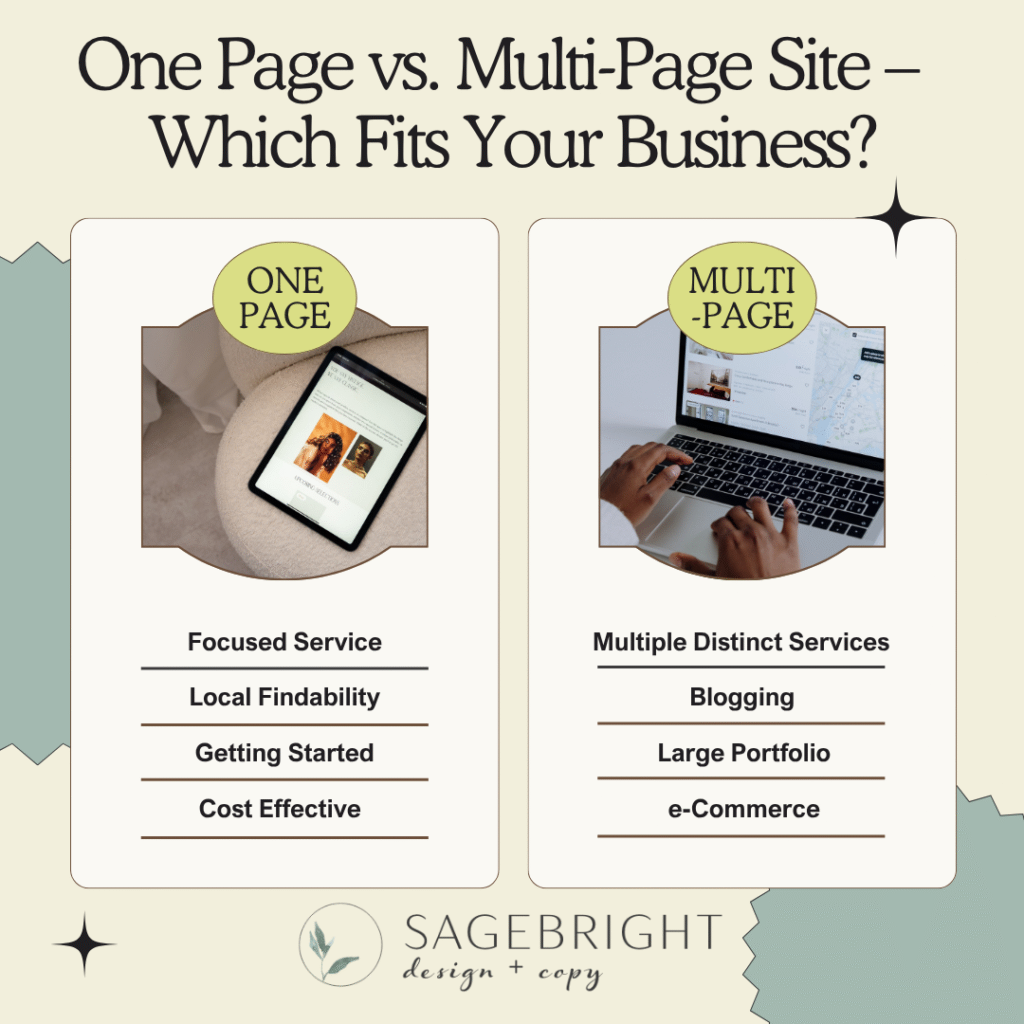
You offer one core service or a tight set of related services. A tile installer, a mobile dog groomer, or a residential window cleaner doesn’t necessarily need a blog or a ten-page service breakdown — they need their phone number front and center with enough context to build trust.
Your goal is to show up and be findable.Local SEO — the process of showing up when someone nearby searches for what you do — works just as well with a one-page site as a multi-page one, as long as the page is built correctly with your location and services clearly defined.
You’re getting started and want a professional presence now. A clean, live website beats a half-finished multi-page project sitting in draft mode indefinitely. Getting something real online is more valuable than waiting for perfection.
When You Might Need More Than One Page
More pages make sense when your business has genuine complexity that a single page can’t reasonably hold.
Consider a multi-page site if:
You offer multiple distinct services that each need their own explanation. A Bend spa that offers massage, facial treatments, and infrared sauna sessions might benefit from separate pages for each — so a first-time visitor looking specifically for a facial isn’t wading through information that isn’t relevant to them.
You want to publish ongoing content. If blogging is part of your marketing plan — and it can be a good one — you’ll need a blog structure, which means a multi-page setup.
You have a large portfolio that needs its own space. A photographer or custom cabinet maker with dozens of project photos may need a dedicated gallery or portfolio section that a single page can’t comfortably hold.
You have an e-commerce component. Selling products directly from your site means you need product pages, a cart, and checkout — that’s a different project entirely.
The Real Question to Ask Yourself
Before deciding on size, ask: What do I need this website to do?
For most service-based businesses, the answer is some version of: help people find me, understand what I offer, and feel confident enough to reach out. A one-page site built with that purpose in mind does all three.
A bigger site doesn’t automatically mean a better site. We’ve seen multi-page websites that were harder to navigate than a single focused page — and one-pagers that consistently converted visitors into paying customers. Size isn’t the measure of effectiveness; clarity is.
Starting Small Doesn't Mean Staying Small
One more thing worth knowing: a one-page site isn’t a dead end. If your business grows and your needs change, it’s straightforward to expand into a multi-page site from a solid foundation. Starting with one page that’s well-built and genuinely useful is a smart move — not a compromise.
The best website is the one that’s live, accurate, and working for you. Everything else can be built from there.
Ready to figure out what makes sense for your business? We’re happy to talk through what you actually need — no overselling, no unnecessary extras. Reach out and let’s figure it out together. We work with small businesses across Central Oregon to build websites that fit where they are right now.